Showing posts with label Kirinyaga. Show all posts

Tuesday, May 8, 2007

SF Online Interview with Hagio (Part IV-1)

Kirinyaga - by Mike Resnick(Continued from Part III)

Mizutama:

Ah, well, let us get back on track here—I think between Dick and Varley on the timeline was William Gibson. Have you read him?

Hagio:

I don't like so-called Cyberpunk and I haven't read any [of his stuff] yet.

Sakai:

So, like "Kirinyaga," you actually like SciFi that externally feels like traditional SciFi.

Hagio:

That's right.

Sakai:

How about the stuff with tons of space aliens?

Hagio:

I like that, too. For that, what I like best is a manga called "Number 7" by Osamu Tezuka.

Sakai:

Speaking of space aliens, I don't recall any shojo manga that were filled with strange space aliens.

Mizutama:

How about "They Were Eleven?" There were a lot of them.

Sakai:

Yes, but they were all basically humanoids. Nothing really strange.

(Continues)

Monday, May 7, 2007

SF Online Interview with Hagio (Part III-2)

2001: A Space Odyssey (film) poster(Continued)

Mizutama:

Do you have any particular type of SciFi you're especially fond of these days? Like, "I am such a sucker for stories with such and such gadgets."

Hagio:

Mmmm. Computers going insane—that's interesting to me. Ever since "2001: A Space Odyssey" I find computers interesting. In the Seafort Saga, was it? —There was a funny computer, too.

Sakai:

The one that goes insane very easily.

Hagio:

Yes, very easily and neatly. So humans calculate using various other methods, rather than computers.

Sakai:

Is it because they go insane that you find computers interesting?

Hagio:

Yes, it is. Because, if you have a computer, be it within spaceship or in a city, its existence implies in a sense that you've conceded full power to it. And if that goes crazy, what else could be more suspenseful?

Mizutama:

So it's fun to think about the possible variations, isn't it: if this happens then it leads to that, and so on. (laugh)

Hagio:

Yes, that gets exciting! (laugh) Oh, by the way, this may be a bit of a jump but I've also gotten fairly hooked by the story of "Evangelion." I saw it after all the episodes had been aired. I borrowed it from someone who highly recommended it. I watched it in sequence from the beginning. I was only told, "You will be surprised at the final and penultimate episodes."

Mizutama:

Wow, that's a very sinful bait that you got tossed. (laugh)

Hagio:

So as I watched, I was wondering how I would be surprised, like when I had been reading "Kirinyaga," thinking about the possible developments. Like, would it go this way or that way. Then at the end—I couldn't believe the ending at all.

Sakai:

Wa haahahaha

Hagio:

But I thought the settings and situation were very interesting.

Sakai:

Have you seen the theatrically released "ending?" [Note 1]

[Note 1] The "Neon Genesis Evangelion" series has three movie version "endings" and I am not sure which one Sakai is referring to. None could be considered an "ending"of the story, actually. A live action version is being produced in the U.S. and THAT is supposed to be the true "ending."

Hagio:

I have it but I haven't managed to watch it yet. Those who watched it told me, "You still don't get [the story] even if you watch it." So I don't know what to do, should I watch it and reconsider? Have you seen it?

Mizutama:

Yes, but please don't ask me to explain it. (laugh)

(Continues)

SF Online Interview with Hagio (Part III-1)

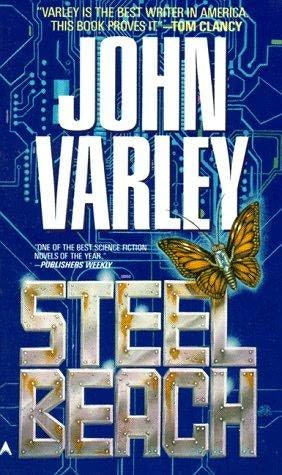
Steel Beach - by John Varley(Continued from Part II)

Sakai:

So what do you read these days in terms of SciFi?

Hagio:

"Steel Beach" was very interesting among things I've read recently. Now I'm looking forward to the final installment that I heard is coming soon—the "Kirinyaga" being serialized in "SF Magazine."

Mizutama:

Ooooh.

Sakai:

Ooooh. I'd better call Hayakawa Shobo and tell them they should write "Acclaimed by Moto Hagio!" on the obi [Note 1] when it gets republished as a book.

[Note 1] Obi is a strip of paper dressed on books in Japan like a belt or obi (the word traditionally refers to a sash for kimono) to cover the lower part of the book's cover where promotional copies are placed. These days almost all books published in Japan come with obi, and your book's resale value will go down without it, so my husband tells you not to throw it away. I find them irritating, since they come loose (you have to keep re-wrapping it around the cover) and don't really have any function other than for PR.

Hagio:

You see, the pacing of the writing is very relaxed, so I cannot help but use the 3% of my brain to think about how it ends. Then at the end, it reaches an [unexpected] conclusion after overturning all the possible variations I could come up with myself—that gives me such pleasure: "Ah, you could make that move!" So for the final installment I have been enjoying thinking about the possible variations.

Sakai:

John Varley often depicts worlds in which sex gets interchanged. [Note 2]

[Note 2] Sexual ambiguity and androgyny are common themes throughout Hagio's works as well.

Hagio:

Yes, "The Ophiuchi Hotline" was also about a society where sex change occurs frequently, but I felt it was more of a fantasy if you depict it without involving personality. But in "Steel Beach" the changes are made at gene level. As the male protagonist transforms into a woman, the author describes how he becomes aware of his gradually feminized self during the process. That was interesting.

Mizutama:

Was it in "The Phantom of Kansas," included in the anthology "The Persistence of Vision," that a protagonist is about to be killed by his sex-changed clone—well, he gets killed in the end—but there is a clone and the one that didn't get a sex change is the original. The story was more focused on identity than the ethics of cloning.

Hagio:

Oh, that sounds interesting.

(Continues)